Harrisburg radon mitigation that ends with a retest
A mitigation system is designed to pull radon below the EPA action level. The test after installation is what proves it did.
Radon mitigation for Harrisburg homes
Radon rises out of the soil and slips into a house through whatever the foundation offers it. Floor cracks. The gap where the slab meets the wall. Sump pits, old floor drains, the joints in a stone foundation. A mitigation system stops the buildup by getting ahead of it: a suction point below the home, a sealed pipe run, and a fan that pulls the soil gas out and vents it above the roofline before it can collect in the rooms where you live.
Harrisburg’s housing stock gives radon plenty of doors. The brick rowhouses in Midtown and on Allison Hill sit over stone and rubble foundations laid a century ago, full of joints that were never meant to be airtight. The postwar ranches and split-levels out toward Colonial Park and Paxtang mostly have block-wall basements, and hollow block gives soil gas its own path upward. Newer townhouses on the West Shore often sit on slabs, where one shrinkage crack is all it takes.
Different entry points call for different systems. That’s the real work of mitigation: reading the foundation, then designing to it.
One thing you should hear plainly: a system is designed to bring the radon level below the EPA action level of 4 picocuries per liter. Designed to. Nobody can honestly promise a specific number before the work is done, because every foundation behaves a little differently. What a good job does promise is a post-installation test, so the result is measured instead of assumed. If the retest isn’t part of the conversation, that’s a red flag.
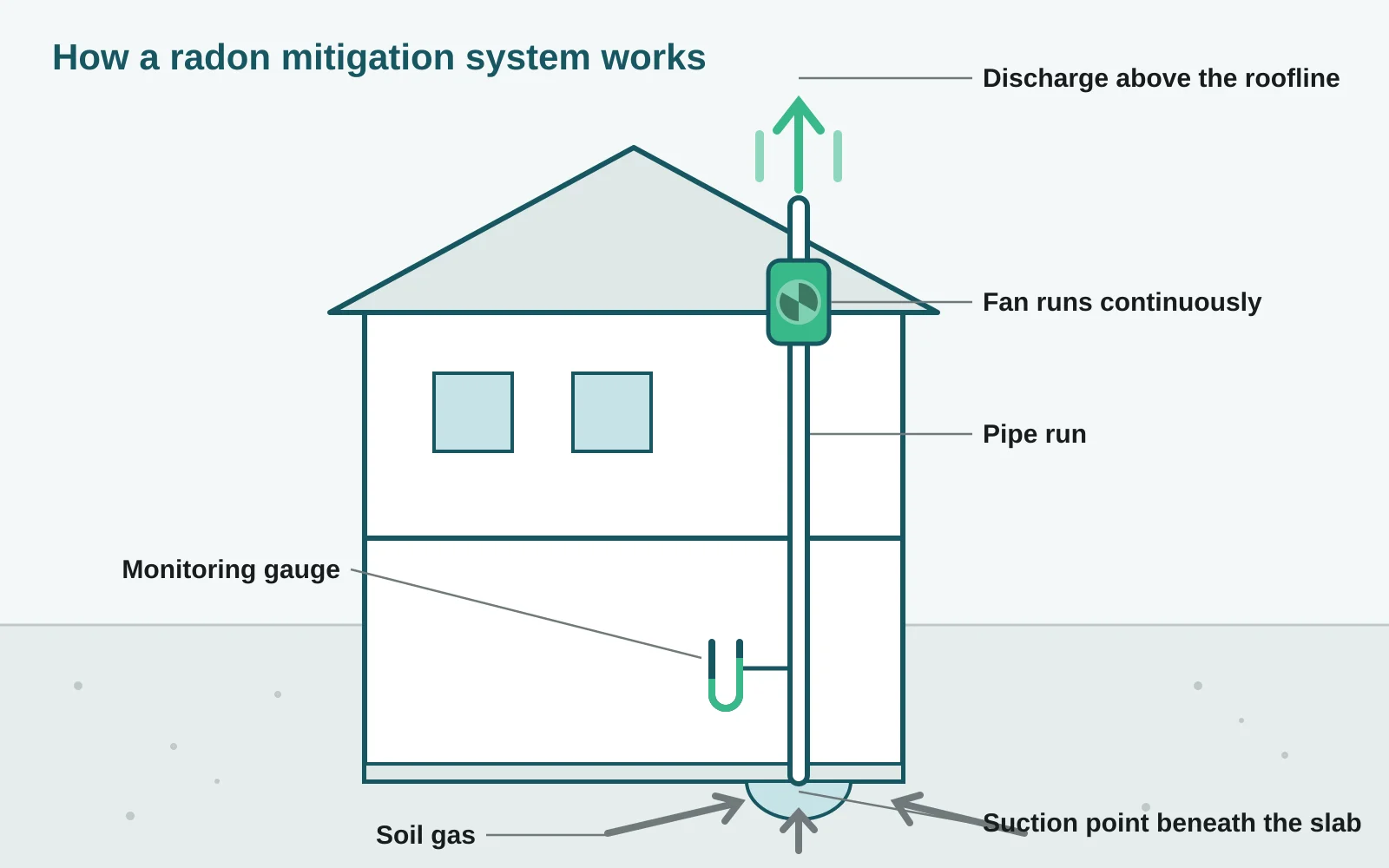
Reading the foundation before picking the fix
Sub-slab suction is the workhorse of this trade. A hole is cored through the basement floor or slab, a pit is dug beneath it, and a pipe with a continuously running fan pulls air from the gravel and soil under the house. In most cases, one well-placed suction point handles an average basement. Larger footprints, or slabs poured in sections, sometimes need two.
Homes with a sump pit or interior drain tile offer a shortcut. The drain loop already reaches under the whole slab, so the system can pull from the sump with a sealed lid. Hollow-block foundations sometimes get wall suction instead, drawing gas out of the block cores themselves.
Dirt-floor crawlspaces are their own problem, solved a different way: a sealed membrane over the soil with suction beneath it. That approach has its own page; see crawlspace radon mitigation for how it works. And many homes built in the region since the 2000s already have a passive radon pipe roughed in from basement to roof. Those homes usually just need a fan added, and activating a passive system is a smaller job than a full install.
What no one can tell you from a website is where your pipe will run, which fan the design calls for, or how the routing will look on your particular house. Layout, foundation, and code decide those. The assessment is where the answers come from.
How a mitigation job usually runs
- 1
Assessment
A look at the foundation, sump, slab, and layout to find where soil gas is getting in.
- 2
Design
The suction points, pipe route, and fan get matched to the foundation type, not copied from a template.
- 3
Installation
The suction point is set, the pipe is run and sealed, and the fan goes in.
- 4
Verification retest
A follow-up radon test measures the new level and documents the result.
The retest is the report card
Here is the standard worth holding any radon work to: the system’s success is demonstrated by a follow-up test, not by the confidence of the person who sold it. After installation, a retest measures the new level. That number — documented, on paper — is the deliverable.
After that, the system mostly asks to be ignored. The fan runs continuously. A small U-tube gauge on the pipe, called a manometer, shows at a glance that it’s still pulling. Uneven fluid means suction; level fluid means the fan has stopped. It’s worth a look every few months, the way you’d glance at a smoke-detector light. Our guide to checking whether a radon system is working walks through the gauge, the sounds, and when a real test is called for.
Start with an assessment, not a quote over the phone
The published scale the work is measured against
Under 2 pCi/L
- What EPA guidance says
- Below the consider-fixing range
- Typical next step
- Retest every few years
2–4 pCi/L
- What EPA guidance says
- Consider fixing the home
- Typical next step
- Confirm with a follow-up test
4 pCi/L and above
- What EPA guidance says
- Fix the home
- Typical next step
- Mitigate, then retest to verify
| Test result | What EPA guidance says | Typical next step |
|---|---|---|
| Under 2 pCi/L | Below the consider-fixing range | Retest every few years |
| 2–4 pCi/L | Consider fixing the home | Confirm with a follow-up test |
| 4 pCi/L and above | Fix the home | Mitigate, then retest to verify |
Ranges and recommendations are from EPA consumer guidance on radon.
Where to go from here
If you’re still staring at a test report and aren’t sure it justifies all this, start with what the numbers on a radon test actually mean: picocuries, action levels, and why two tests of the same house can disagree.
If the radon result surfaced in a home purchase, the clock changes everything. Radon service for real estate transactions covers testing and mitigation on a closing timeline, with the documentation the deal needs.
And if you already have a system, remember that fans wear out on a roughly ten-year cycle. A silent fan protects nobody, and plenty of owners don’t notice for months because the pipe looks exactly the same either way. When the gauge goes flat or the hum changes, radon fan replacement is a quick fix, far quicker than the original install, since the pipe, the routing, and the roof penetration are already done.
Frequently Asked Questions
Will a system get my house below 4 pCi/L?
Systems are designed to bring levels below the EPA action level, and most homes respond well to a properly designed system. No honest contractor promises a specific number before the work is done. The post-installation test is what verifies the result, and that retest is the standard the work should be held to.
How disruptive is the installation?
Less than most homeowners expect. A typical residential install involves drilling one suction point, running pipe, mounting a fan, and sealing accessible entry points. Foundation type and pipe routing drive how long it takes, so the honest answer for a specific home comes after the assessment.
Where will the pipe and fan go?
It depends on the home. Some systems route up through a garage or utility chase and out the roof. Others run up an exterior wall. The foundation, the layout, and code requirements decide it, and the options get walked through during the assessment rather than guessed at from a website.
How long do radon fans last?
Most fans last on the order of a decade, in industry experience. They run around the clock, so they do eventually wear out. The small gauge on the pipe is usually how owners find out a fan has quit, which is why it's worth a glance now and then.
Do I need to retest after the system is installed?
Yes. The retest is the whole point. It verifies the system actually brought the level down. After that, periodic retesting every couple of years is standard practice, because the gauge only shows the fan is pulling, not what the indoor level is.
Can't I just seal the cracks instead?
Sealing alone doesn't reliably hold radon levels down, and EPA guidance is direct about that. Soil gas finds the openings that remain. Sealing is part of many mitigation jobs, but the fix that works is active suction below the home, venting the gas before it gets inside.
Does a mitigation system help or hurt resale?
In a region where radon is this common, a documented system with a verified retest is usually a plus. It means the question every buyer's inspector will raise is already answered. Pennsylvania's disclosure form asks about radon, so a solved, provable problem beats an unknown.