How Radon Mitigation Works
The invisible fix for the invisible problem
Radon mitigation is hard to picture, and the industry mostly doesn’t help. You’re told an invisible gas is entering your home, that a system will remove it, and that afterward nothing visible will have changed. You can’t see the problem, then you pay for a fix you also can’t see working.
This guide exists to make the machine visible.
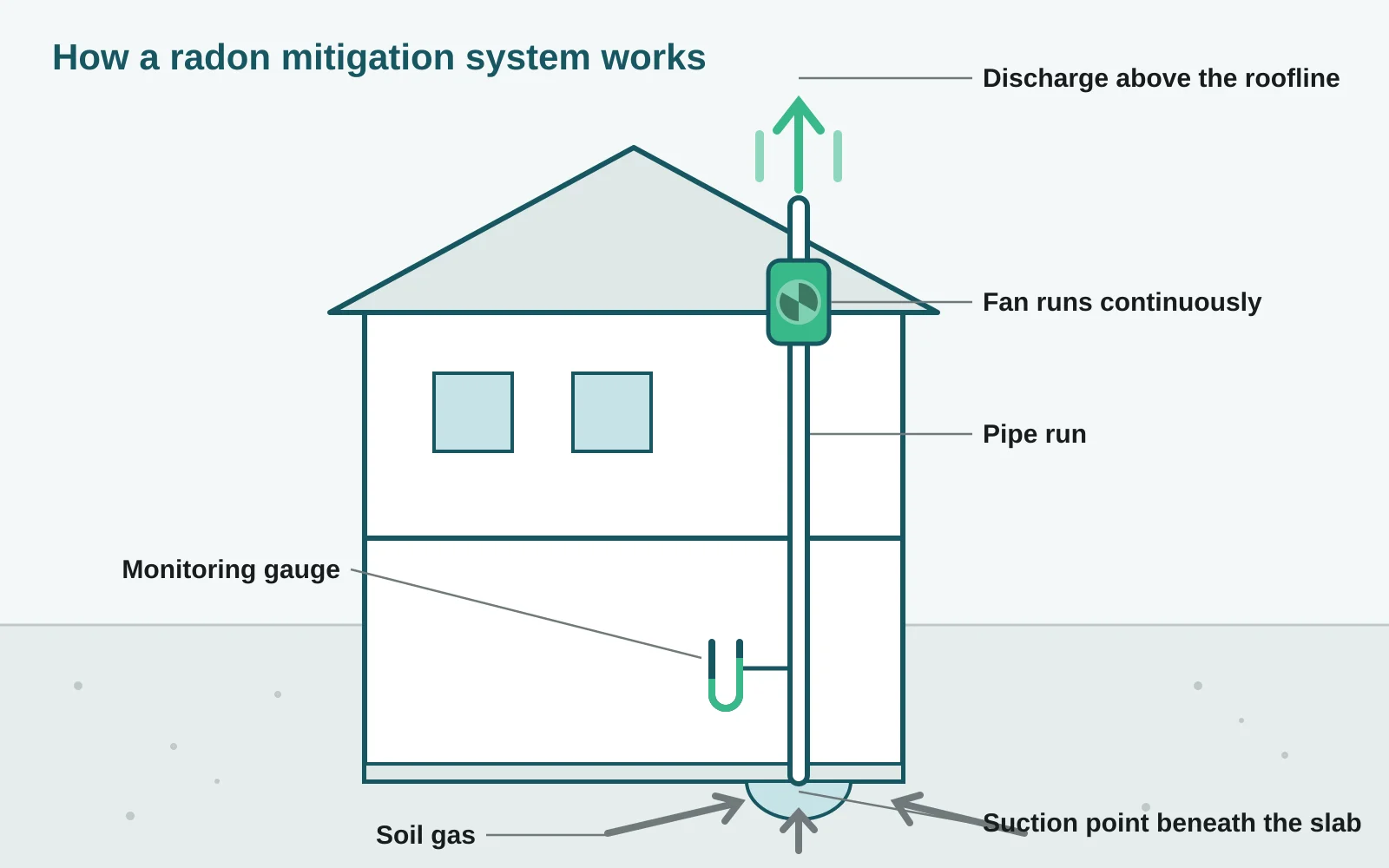
Here’s the one-sentence version: a mitigation system collects soil gas from beneath your home before it can get inside, vents it through a pipe above the roofline, and then a follow-up test proves the indoor level came down. Collect below, vent above, verify with a number. Every component in the diagram serves one of those three jobs.
The idea is old, boring engineering, and that’s a compliment. It’s the same principle as a chimney: create a path of least resistance, add draft, and the gas follows the path you built instead of the cracks in your floor. No filters to change monthly, no chemicals, no sealed-off rooms. A pipe and a fan, placed with some intelligence.
The intelligence is the part you’re actually buying, which is why the mitigation service page talks so much about assessment and design. But first, meet the parts.
The anatomy, piece by piece
The suction point. A hole cored through the concrete slab, with a small pit hollowed out beneath it. This is where the system grabs the soil gas. Placement matters more than it looks. The goal is a spot from which suction can reach under the whole slab through the gravel layer. Homes with a sump pit sometimes skip the coring entirely: the sump connects to drain tile that already runs beneath the floor, so the system pulls from a sealed sump lid instead.
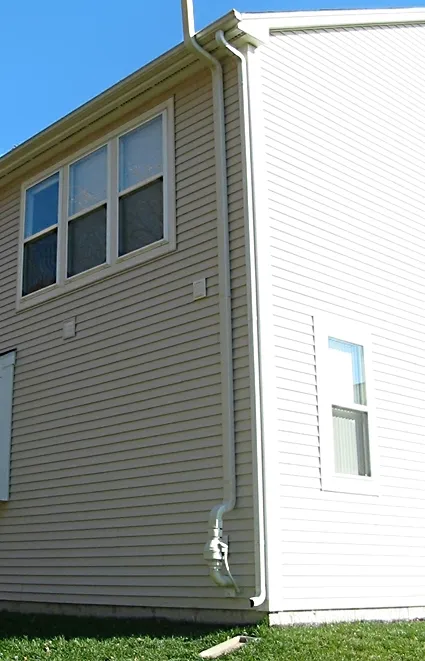
The pipe run. Three- or four-inch PVC, sealed at every joint, carrying the gas from the suction point to the outdoors. Some runs go up through closets and the attic, invisible from the street. Others climb an exterior wall. Routing is a house-by-house decision balancing looks, cost, and code.
The fan. The heart of the system, mounted in the attic or outside, never in living space, so a leak on the pressure side can’t discharge into the house. It runs continuously, sipping electricity like a light bulb, and creates the vacuum that makes everything work.
The discharge. The pipe ends above the roofline, where the gas disperses and dilutes into outdoor air, away from windows and intakes.
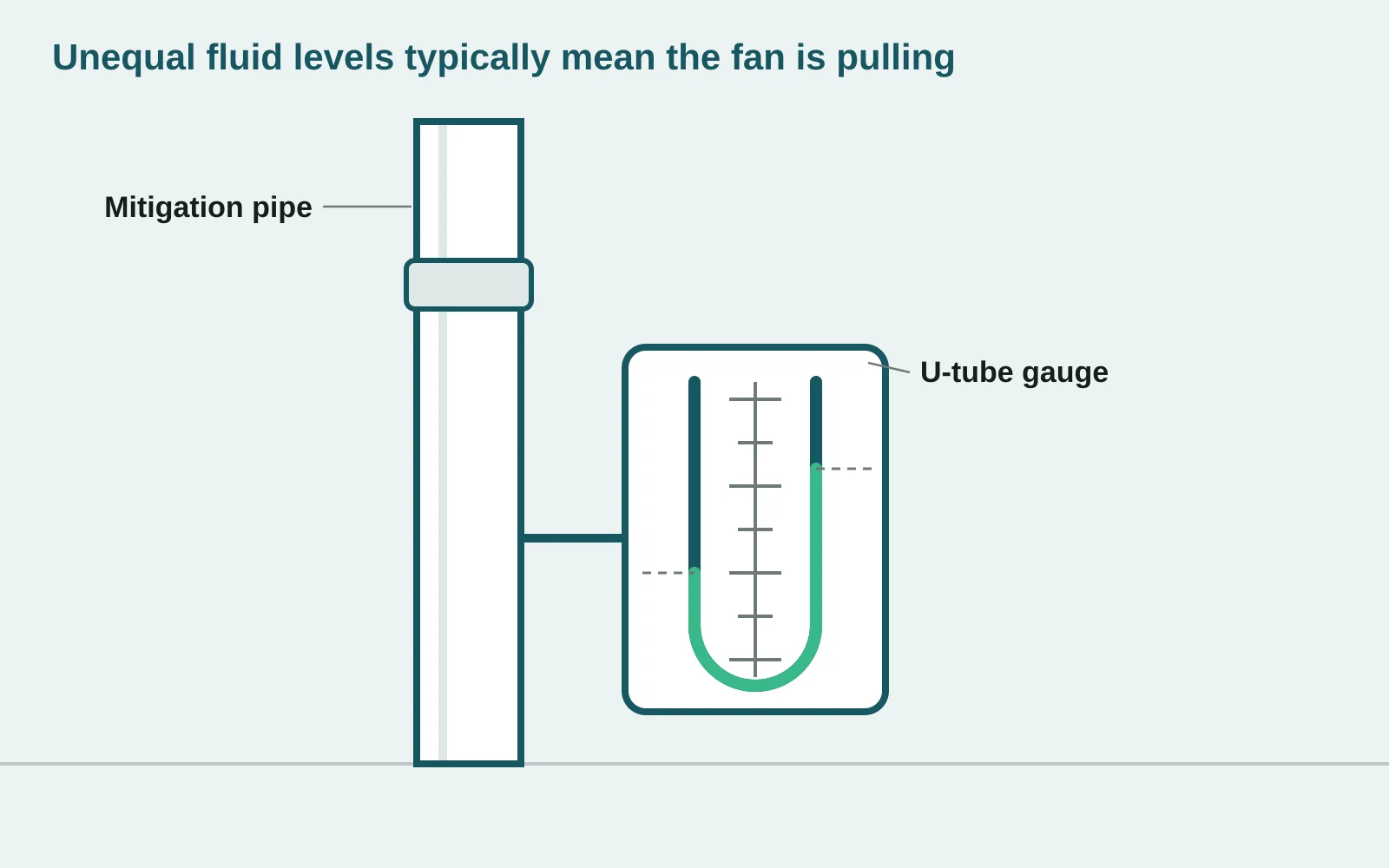
The gauge. A U-shaped tube of colored fluid on the pipe, called a manometer. Unequal fluid levels mean the fan is pulling. It’s the system’s only dashboard.
Foundations change the recipe. Slabs and basements get the sub-slab version above. Dirt crawlspaces get a sealed membrane over the soil with suction beneath it. Combined foundations mix methods on one fan. Which design fits which house is what the assessment determines. The industry has the patterns; your foundation picks one.
Want this working in your home? Start with an estimate.
Verification: the step that makes it real
Every part above is just plumbing until somebody measures the result.
Mitigation systems are designed to bring indoor radon below the EPA action level. Designed to — not guaranteed to hit a specific figure, because every slab, soil bed, and house-pressure profile behaves a little differently. The trade’s honest answer to that uncertainty is the post-installation test. A few days after the fan starts, a new test measures what the system actually achieved, in writing. That number is the deliverable. If a mitigation conversation doesn’t include the retest, the most important part is missing. (If reading results is new to you, what the numbers mean decodes the units and the scale.)
Verification doesn’t end there, either. The gauge gives you a five-second daily answer to “is it still pulling?”, and a periodic retest every couple of years confirms the number is holding, since fans age and houses change. The owner’s routine, gauge checks and all, is laid out in is my radon system working?
That’s the honest shape of quality in this trade: not promises up front, but measurements at the end.
Three fixes that don’t fix it
Some sincere-sounding alternatives come up in every radon conversation. All three fail for documented reasons, so here they are, corrected without ridicule.
“We’ll just air the basement out.” Ventilation moves the number only while the air is moving. Open windows dilute radon, then the house closes and the level climbs right back. In winter, conditioning all that incoming air costs real money besides. EPA guidance treats natural ventilation as a temporary measure, not mitigation.
“Our air purifier handles it.” Filters and purifiers capture particles. Radon is a noble gas; it sails through HEPA media untouched. A purifier can catch some radon decay products already in the air, but it does nothing about the gas itself or the source feeding it.
“Seal the cracks and be done.” The most intuitive one, and EPA guidance is direct about it: sealing alone hasn’t been shown to lower radon levels significantly or lastingly. Soil gas is patient; it finds the gaps that remain, and concrete keeps making new ones. Sealing earns its keep as a supporting player: good systems seal accessible entry points so the fan’s suction works harder where it counts.
What works is the machine this page just walked through: active suction below the home, a vent above it, and a retest with a number on it. When you’re ready to talk about your own house, radon mitigation is the place to start.